
Available
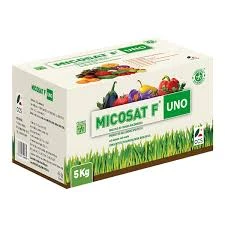
MYCOSAT F ONE FERTILISER WITH MYCORRHIZAE 5KG
Cod. MICOUNO
Brand: MICOSAT CCS
MICOSAT F UNO acts through synthesis and translocation of polyphenolic substances. Among other characteristics, this biological fertiliser contributes to the restoration of soil restocks, improves...
Standard price
€203,02 VAT included(4%)
 Recalculation in progress …
 MICOSAT F UNO acts through synthesis and translocation of polyphenolic substances. Among other characteristics, this biological fertiliser contributes to the restoration of soil restocks, improves root development and reduces the plant transplant crisis.
Microorganisms making up the microbiota per 100 g of product
40% Symbiotic fungi (Glomus spp. GB 67, G. mosseae GP 11, G. viscosum GC 41) 18.60% C.F.U./g: 12.4 x 10⁷ Rhizosphere bacteria (Agrobacterium radiobacter AR 39, Bacillus subtilis BA 41 and Streptomyces spp. SB 14) Saprophytic fungi (Pochonia chlamydosporia PC 50 and Trichoderma harzianum TH 01) Yeasts (Pichia pastoris PP 59)
MICOSAT is not only a strong promoter of the biotic processes occurring between the roots and the soil, but is also a means of defending plant roots from attacks by various parasitic fungi, such as: PHYTOPHTHORA SPP - RHIZOCTONIA - PYTHIUM - but in particular ARMILLARIA MELLEA
Mycosat F is a collection of arbuscular mycorrhizae, rhizosphere bacteria and saprophytic fungi in a symbiotic relationship with plant roots. This biological community constitutes a biocenosis, i.e. a collection of populations of different species living in the same natural environment and between which relationships of interrelation and interdependence are created. Mycorrhizae represent a type of symbiotic association between a fungus (Glomus) and a higher plant, localised within the root system of the plant symbiont, and extending through the hyphae rhizosphere and into the surrounding soil. These symbioses are mutualistic, whereby the two organisms carry out their life cycle by living in close contact and deriving mutual benefits, both nutritional and otherwise. Saprophytic bacteria and fungi play an important role in improving the assimilative chain and enhancing the natural defences of plants.
Microorganisms making up the microbiota per 100 g of product
40% Symbiotic fungi (Glomus spp. GB 67, G. mosseae GP 11, G. viscosum GC 41) 18.60% C.F.U./g: 12.4 x 10⁷ Rhizosphere bacteria (Agrobacterium radiobacter AR 39, Bacillus subtilis BA 41 and Streptomyces spp. SB 14) Saprophytic fungi (Pochonia chlamydosporia PC 50 and Trichoderma harzianum TH 01) Yeasts (Pichia pastoris PP 59)
MICOSAT is not only a strong promoter of the biotic processes occurring between the roots and the soil, but is also a means of defending plant roots from attacks by various parasitic fungi, such as: PHYTOPHTHORA SPP - RHIZOCTONIA - PYTHIUM - but in particular ARMILLARIA MELLEA
Mycosat F is a collection of arbuscular mycorrhizae, rhizosphere bacteria and saprophytic fungi in a symbiotic relationship with plant roots. This biological community constitutes a biocenosis, i.e. a collection of populations of different species living in the same natural environment and between which relationships of interrelation and interdependence are created. Mycorrhizae represent a type of symbiotic association between a fungus (Glomus) and a higher plant, localised within the root system of the plant symbiont, and extending through the hyphae rhizosphere and into the surrounding soil. These symbioses are mutualistic, whereby the two organisms carry out their life cycle by living in close contact and deriving mutual benefits, both nutritional and otherwise. Saprophytic bacteria and fungi play an important role in improving the assimilative chain and enhancing the natural defences of plants.
-
1