
Available
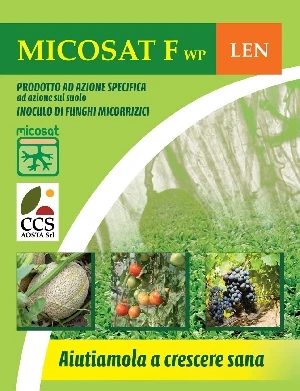
MYCOSAT F WP LEN BIOSTIMULANT WITH MYCORRHIZAE 100G
Cod. MILEN
Brand: MICOSAT CCS
Field of action: increasing plant resistance against nematodes by increasing mycorrhizal colonisation.
Mycosat F is a collection of arbuscular mycorrhizae, rhizosphere bacteria and...
Standard price
€14,32 VAT included(4%)
 Recalculation in progress …
Field of action: increasing plant resistance against nematodes by increasing mycorrhizal colonisation.
Mycosat F is a collection of arbuscular mycorrhizae, rhizosphere bacteria and saprophytic fungi in a symbiotic relationship with plant roots.
This biological community constitutes a biocenosis, i.e. a collection of populations of different species living in the same natural environment and between which relationships of interrelation and interdependence are created.
Mycorrhizae represent a type of symbiotic association between a fungus (Glomus) and a higher plant, localised within the root system of the plant symbiont, and extending through the rhizosphere and into the surrounding soil. These symbioses are mutualistic, whereby the two organisms carry out their life cycle by living in close contact and deriving mutual benefits, both nutritional and otherwise.
Saprophytic bacteria and fungi play an important role in improving the assimilation chain and enhancing the plants' natural defences.
Advantages and actions carried out by the product Thickening of the cell wall of the root cortical layer and thickening of cuticular waxes Mycorrhizal colonisation leads to a considerable expansion of the root system, which is associated with an increased production of phenols and protein groups (proteases, amylases and peptides.
Mycosat F is a collection of arbuscular mycorrhizae, rhizosphere bacteria and saprophytic fungi in a symbiotic relationship with plant roots.
This biological community constitutes a biocenosis, i.e. a collection of populations of different species living in the same natural environment and between which relationships of interrelation and interdependence are created.
Mycorrhizae represent a type of symbiotic association between a fungus (Glomus) and a higher plant, localised within the root system of the plant symbiont, and extending through the rhizosphere and into the surrounding soil. These symbioses are mutualistic, whereby the two organisms carry out their life cycle by living in close contact and deriving mutual benefits, both nutritional and otherwise.
Saprophytic bacteria and fungi play an important role in improving the assimilation chain and enhancing the plants' natural defences.
Advantages and actions carried out by the product Thickening of the cell wall of the root cortical layer and thickening of cuticular waxes Mycorrhizal colonisation leads to a considerable expansion of the root system, which is associated with an increased production of phenols and protein groups (proteases, amylases and peptides.
-
40